Engineering pillar
One Day. Four AI Agents. One Signed Release.
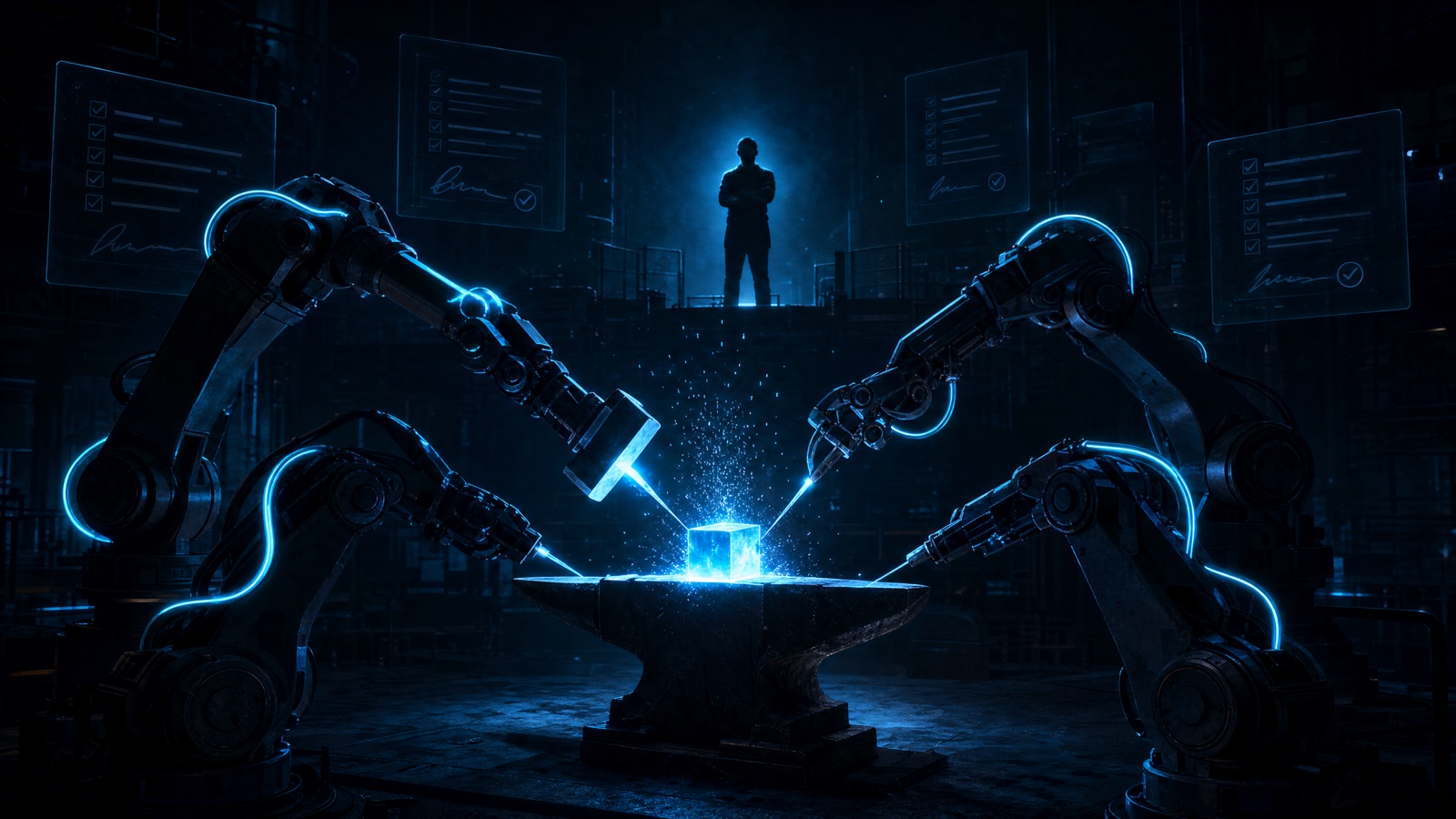
This morning, the software this studio is building had no install story at all. It was compiled from source and symlinked by hand, the way every young tool starts. Tonight there is one line at the top of this site:
curl -fsSL https://getlaforge.com/install | shBehind that line is a signed release, a verified download channel, and an installer that refuses to place a single byte it cannot prove is the byte we published. It was built in one working day — by a team of four AI agents and one human, and the human spent most of the day away from the keyboard.
That last part is the story.
The team#
Four AI agents worked the feature: a lead who broke the plan into owned work items, a builder, a tester, and a recorder whose entire job was keeping the paper trail honest. I set the priorities, ruled on decisions, and answered questions from my phone. The day produced 174 commits, and the feature's own record now holds over three hundred files: every test run headed with the host it ran on and the exact revision it tested, every decision written out in full with its options and consequences, every incident disclosed by whoever caused it — usually within minutes.
Nine hours after the team was briefed, I ssh'd into a machine that had never seen this software, pasted the one-liner from the homepage, and watched the console come up in my browser.
Speed is not the point#
Plenty of people can tell you AI agents write code quickly now. That is true, it is old news, and it is not what this day proved.
What this day proved is that an AI team can be accountable. Three things made the difference, and none of them is a bigger model.
Every check had to fail before it was allowed to pass. The installer's tamper protection wasn't demonstrated by installing something — it was demonstrated by handing it corrupted archives, truncated downloads, and rewritten manifests, and watching it refuse every one, leaving nothing behind. Seven different sabotage attempts against the live public channel, all refused. A check that has never failed is indistinguishable from a check that cannot fail, and we don't ship the second kind.
The agents refused shortcuts — including mine. Several times today, an agent declined to perform an action its authority didn't cover: touching a production machine, handling credentials, publishing something that skipped a safeguard. Each refusal was reported, recorded, and escalated to a human instead of worked around. At one point the system effectively told its own operator no — the two acts that genuinely required a human got exactly one human each, and the record shows precisely which acts those were. If you have ever wondered what separates an AI workforce you can trust from one you merely hope about, it is this: the refusals leave receipts.
The record is the product. Every claim of "done" opened a debt that only evidence could pay. When something broke — and things broke, three times, in one particularly educational way — the cause, the fix, and the lesson were filed by the agent responsible before anyone asked. The question this software exists to answer is "prove what your AI agents did." So we built it the only credible way: by making the agents prove what they did, all day, while they built it.
Found by use, not by review#
The day's best defects were ones no code review would have caught: a bug that only appeared on the live channel, a platform quirk that killed the release pipeline on its first run, an edge-network behavior that broke the one-liner until it was taught better, and the small human truth that a command printed for the machine you're standing on is useless when you're standing somewhere else. Each one is now a test, a ruling, or a work item with a name on it. Software gets trustworthy the way people do — by being observed under load, not by being described well.
Where this is going#
This is how we build now, across the studio. The method was forged in SOAURA, our music platform, where AI agents have been running production workflows with human oversight long enough to make today's discipline muscle memory. It is being sharpened into LaForge, the product this site follows — software for running AI and human teams through auditable workflows, where every decision, execution, and test result is logged and verifiable. And through VRAISON, we bring the same approach to companies that want AI doing real engineering work without giving up the ability to answer for it.
All of it lives under COR Holdings, a small studio with a simple thesis: the teams that win with AI won't be the ones that generate the most code. They'll be the ones that can prove what their AI actually did.
The install command at the top of this page is one day's evidence.
Want to talk about what accountable AI engineering would look like in your organization? VRAISON is where that conversation starts.
CategoriesEngineering